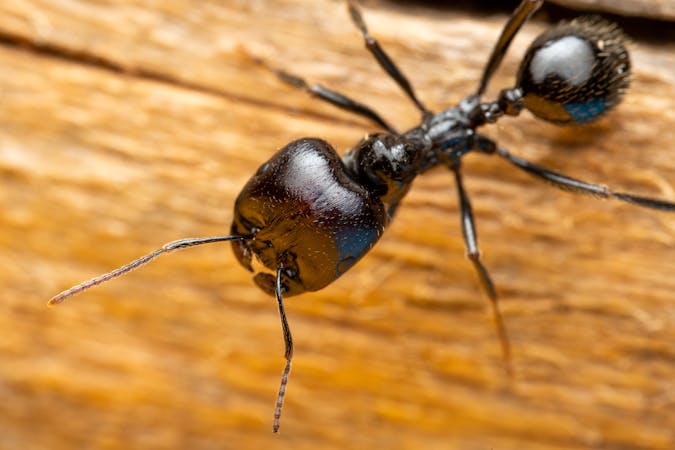
Every spring in New York City, a familiar visitor returns — and it's not the cherry blossoms. Carpenter ants begin showing up inside Manhattan apartments as temperatures climb above 50°F, emerging from wall voids, window frames, and moisture-damaged wood where they've spent the winter. If you're spotting large black ants trailing across your kitchen counter or bathroom floor, this guide will help you understand what you're dealing with and what to do next.
What Are Carpenter Ants?
Carpenter ants (Camponotus pennsylvanicus) are one of the largest ant species found in New York. Workers typically measure between 1/4 and 1/2 inch in length, and reproductive swarmers can reach up to 3/4 inch. Unlike termites, carpenter ants do not eat wood — they excavate it to create nesting galleries, pushing out a fine, sawdust-like material called frass.
In Manhattan apartments, they're frequently confused with regular house ants, but the size difference is significant. House ants are tiny, usually 1/16 to 1/8 inch. If the ants you're seeing are visibly large, black or dark brown, and moving purposefully along a defined trail, carpenter ants are the most likely culprit.
Why Spring Brings Carpenter Ants Indoors in NYC
Carpenter ants establish parent colonies outdoors in decaying wood — tree stumps, old fence posts, firewood piles, and the structural lumber of older buildings. Manhattan's aging housing stock, much of it built before World War II, provides ideal nesting habitat.
In spring, two things happen simultaneously. First, the colony warms up and becomes active again. Second, mature colonies produce winged reproductives (swarmers) that fly out to start new satellite colonies. These satellite colonies are what most Manhattan residents are dealing with — a group of workers that has moved indoors to exploit a moisture source or food supply near the parent nest outside.
Common entry points in NYC apartments include:
Signs of a Carpenter Ant Infestation in Your Apartment
Spotting one or two ants doesn't necessarily mean you have an established colony indoors. But certain signs suggest a more serious problem:
Because carpenter ants are attracted to moisture, the presence of an infestation often signals an underlying water problem. Addressing the moisture is just as important as eliminating the ants themselves.
DIY Prevention: Sealing Entry Points and Fixing Moisture
For residents who want to reduce their risk this spring, these steps make a real difference:
Seal Cracks and Gaps
Eliminate Moisture Sources
Reduce Attractants
When to Call Professionals
DIY prevention works well for keeping carpenter ants out, but once a satellite colony is established inside your apartment walls, store-bought sprays rarely solve the problem. Consumer sprays often only kill the visible foragers, leaving the colony intact and causing it to splinter into multiple sites.
You should contact a licensed pest management professional when:
In co-ops and condos, it's worth notifying building management as well. Carpenter ant satellite colonies in Manhattan often originate from a parent colony in the building's structural wood or a neighboring unit, and the problem may require a building-wide inspection.
Eco-Friendly Treatment Options from OPC NYC
Our NYPMA-certified technicians use targeted, low-impact approaches that are effective against carpenter ants while minimizing chemical exposure in your living space.
Borate-based treatments applied directly to wood surfaces disrupt the ants' ability to metabolize food and are far less toxic than synthetic pyrethroids. Botanical gel baits placed in wall voids and along ant trails allow workers to carry active material back to the colony, addressing the source rather than just the symptom. When a direct void treatment is needed, we use diatomaceous earth and other physical desiccants that work mechanically rather than chemically.
We always pair treatment with a thorough inspection to identify moisture issues and structural vulnerabilities — because the most effective carpenter ant control addresses the conditions that attracted them in the first place.
Frequently Asked Questions
How do I tell carpenter ants apart from termites in my NYC apartment?
Carpenter ants have a pinched waist, bent antennae, and if they're swarmers, their front wings are longer than their rear wings. Termite swarmers have a thick, unsegmented waist, straight bead-like antennae, and equal-length wings. Carpenter ants are also much larger. If you're unsure, a photo sent to a licensed exterminator can usually confirm identification within minutes.
How long does a carpenter ant infestation take to develop in an apartment?
Satellite colonies can establish themselves in as little as a few weeks once workers find a viable nesting site with moisture and food nearby. Mature infestations with multiple satellite colonies can develop over one to two seasons if left untreated. The sooner you act, the less structural damage and disruption you'll face.
Are carpenter ants in NYC apartments dangerous to my health?
Carpenter ants do not sting and rarely bite unless directly handled. They do not carry or transmit disease. However, the structural damage they cause over time — particularly to moisture-softened wood in older Manhattan buildings — can become costly. The greater concern is what an infestation signals: an unaddressed moisture problem that may also be contributing to mold growth.
What are the signs that carpenter ants are in my walls?
The most reliable sign is frass — fine, sawdust-like debris with insect body parts — near baseboards, behind appliances, or in cabinet corners. You may also hear faint rustling or crinkling inside walls at night when the apartment is quiet. Consistent ant trails leading to and from the same wall void are another strong indicator that a colony is nesting inside.